All posts by thurstonclarke.com

Author

Pearl Harbor Ghosts

pearlharborghosts
Pearl Harbor Ghosts: The Legacy of December 7, 1941 (Ballantine, 2001)
Order the book

amazon  barnesandnoble

Download the eBook

kindle  nook

“Clarke’s ability to evoke the feel and mood of Hawaii then and now will remind readers of Jan Morris and Joan Didion.”

The Washington Post

Synopsis

A landmark book published to rave reviews a decade ago, Pearl Harbor Ghosts has now been updated to commemorate the 60th anniversary of the surprise attack that forever changed the course of history.

More Reviews below
Excerpt below

Book on Television: Pearl Harbor Ghosts was the basis for a two-hour prime time CBS documentary introduced by General Normal Schwartzkopf.

Full of gripping drama and vibrant details, here is the intimate human story of the events surrounding that fateful day of December 7, 1941–the glamorous tropical city that seemed too beautiful to suffer devastation . . . the stunned naval personnel whose lives would permanently be divided into before and after Pearl Harbor . . . the ordinary Honolulu residents who were tragically unprepared to be the first target in the Pacific war . . . the Japanese pilots who manned the squadron of deadly silver bombers . . . and the island’s community of Japanese-Americans whose lives would never be the same again.

Blending meticulous historic recreation with lively reporting, Clarke counterpoints the freeze-frame nightmare of the 1941 bombing with the disturbing realities of present-day Honolulu, where hundreds of veterans, both American and Japanese, converge each year to relive every hour of the attack. Wealthy Waikiki landowners and native Hawaiian farmers, admirals and nurses, Navy wives and government officials–all take their part in Clarke’s rich tapestry of memory and insight. In the end, Pearl Harbor emerges as a trauma that spread from Oahu to engulf the nation and the world–an event that continues to reverberate in the lives of all who experienced it.

More reviews of Pearl Harbor Ghosts

“Filled with fascinating stories told by ordinary people who lived through the extraordinary weekend of December 5 to 7, 1941.”

The New York Times Book Review

“An extremely sensitive book by a sensitive writer.”

Christian Science Monitor

“Thurston Clarke’s Pearl Harbor Ghosts stands apart from other 50th anniversary examinations of that tragic day.”

Chicago Tribune

“A penetrating and provocative study of the attack’s evolving impact on Japanese-American relations and on Hawaii itself over the past half-century. It is distinctly the most illuminating volume among the wave of books being launched…to coincide with the impending 50th anniversary.”

Chicago Sun-Times

“Unforgettable… Clarke is masterful in the personal realities… Woven into the dreamlike tapestry are sharp, provocative bits on contemporary Japanese-US realities… Powerful, compelling prose lays this ghost to rest with dignity and painstaking honesty.”

Kirkus

Excerpt

In 1941, Honolulu was a city where people advertised for a ‘Hawaiian yard boy who can sing, dance, and play the guitar,’ and taxi drivers used call boxes attached to palm trees, and you requested a favorite driver by name. It was a city where a siren ordered minors off the streets at eight o’clock, beachboys had names like Hankshaw, Steamboat, Panama, and Tough Bill, who played the ukulele and tucked hibiscus blossoms behind their ears, policemen wore leis and sat on high stools under umbrellas, waving at friends as they pulled ‘Stop’ and ‘Go’ levers, and Pete the ‘Hula Cop’ directed traffic with the arm motions of a hula dancer, and was honored by a downtown plaque thanking him for having ‘smiled his way into the hearts of the people.’ It was a city where the most serious civic nuisances were an absence of shade trees along Kalakaua Avenue and bad-mannered children on the trolley buses, politicians wore white suits and panama hats, and promised the moon in several languages, and hostesses descended from early missionaries used ti leaves as tablecloths and sang the doxology before dinner.

Trace the paths of the Japanese fighters and bombers over a map of Oahu and the island begins to resemble an insect caught in a dense spiderweb of lines and arrows, and you can appreciate how confusing the attack must have been for American forces on the ground. The most chaotic and damaging period was the first half hour, from 0755 until 0825, when more than twenty ships were attacked by 183 Japanese fighters and torpedo, dive-, and high bombers. This was when Oahu’s defenders suffered the heaviest material losses and casualties, when great battleships capsized and sank in flames and Japanese pilots destroyed or damaged most of the 188 Army and Navy planes lost on December 7.

On the night of December 7, the first night of a blackout and curfew that would last almost three years, civilians saw shells flashing like sheet lightning, and the dull red glow of burning battleships, projected onto the night sky. At midnight, they saw a rare lunar rainbow, which native Hawaiians believe symbolizes an imminent victory. All night, they felt the ground shaking from trucks trailering artillery pieces, and heard the rifle shots of nervous guards, the antiaircraft fire of panicky gunners, and the grinding gears of mortuary wagons transporting the dead to cemeteries in Nuuanu Valley.
California Fault

 californiafault
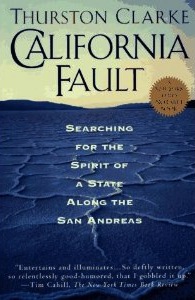
California Fault: Searching for the Spirit of a State Along the San Andreas (Ballantine, 1997)
Order the book

amazon  barnesandnoble

“Delightfully eclectic . . . Move over, Alexis de Tocqueville. When Thurston Clarke makes the UFO-earthquake connection halfway through Fault, he elevates himself to the first rank of America’s social observers.”
Los Angeles Times

Synopsis

California has always symbolized the good life, but social problems and natural disasters have tarnished the image of the Golden State.

To find out what happened to the California Dream, Clarke sets off on a remarkable journey down the San Andreas fault searching for earthquakes and good news.

More reviews and excerpt below
Other Links and Media

From the “sensitive” whose headaches predict earthquakes with uncanny precision to a determined dreamer at the Salton Sea who hopes someday to build a blue-collar resort along the abandoned shores, Clarke introduces us to a memorable cast of eccentrics, asking each the provocative question: What is it like living in a place that–no matter how beautiful–might suddenly, while you opened the cereal, combed your hair, or bathed the baby, strike you dead?

More Reviews of California Fault

“Vivid and continually surprising… The author has an unerring ability to search out exactly the right despoiler, utopian, or local eccentric to illuminate the history and character of each stop along the way.”
The New Yorker

“His enthusiasm is infectious… he entertains and illuminates, writing gracefully, and with a fine sense of irony…The book is so deftly written, so relentlessly good-humored, that I gobbled it up…He’s funny and he’s fair and he swims well against powerful cultural cross-currents.”
New York Times Book Review

“He has a nice touch and a close eye. Like novelist John Updike, he has the ability to raise the stature of the mundane and to make an interesting prose purse out of a sow’s-ear situation.”
Philadelphia Inquirer

“Clarke’s acerbic wit and vivid description are a pleasure throughout…As tough in its critique of the Golden State as it is shrewd in its understanding, California Fault is a book to savor.”
Seattle Times

“Witty, engaging… It gave me much pleasure.”
Washington Post Book World

“A wonderful book from one of our best travel writers.”
Portland Oregonian

“A nearly edible travelogue — smooth as mousse, full of savory tidbits, and memorable.”
Kirkus

“Provocative and absorbing… Clarke’s clean, punchy prose and his novelist’s eye for detail make California Fault a breezy, trenchant read.”
Santa Cruz Sentinel

“I lived in the Golden State in the Seventies, just before the tarnish, the fool’s gold, and Proposition 13. Now comes Mr. Clarke, an adventurous investigator. In his persistent wandering he uncovers a cornucopia of America’s disappointed dreams. We hear the voices of wanderers, settlers, ex-communards, and working philosophers. The closeness of dream and dread is still thrilling and comes through. I wiped my eyes.”
Andrei Codrescu

“This is a brilliant, mordantly funny book, and Clarke’s vision of the San Andreas Fault is powerful and true. He’s a dark millenarian who’s given us a beautifully complex metaphor, and if California at century’s end is America’s future, then we’re all living on the Fault, and the Big One’s due any minute.”
Russell Banks

Excerpt

Along the north coast, gas stations had been good places for meeting people, but here they were designed to protect employees from customers and you paid a cashier in an upright Plexiglass coffin before you pumped, a double reminder of how little you were trusted. It was no good trying to talk to people at the K-Marts or Long’s Drugs either. They were not places to linger, and the clerks were busy and bored. Most towns no longer had thriving downtowns because, despite the advertising nostalgia for Norman Rockwell Main Street America, Californians were like most Americans: cold-blooded community killers. Ready to administer the coup de grace to merchants who had sponsored decades of Little League teams and high-school yearbooks in order to shave some pennies off a tube of Colgate.

[Berkland] had become a clearinghouse for seismically sensitive pet stories…The week before the 1980 Eureka earthquake they fielded 853 complaints of dogs wandering on highways and cows on the wrong side of a field. A Dr. Deshpande in India, who had documented abnormal animal behavior before subcontinent earthquakes, sent him a paper by Soviet scientists mentioning how an hour before the 1988 Armenian earthquake, ‘a very tame pet hamster bit his owner for the first and only time.’ A veterinarian reported crystals forming in the urinary tracts of cats just before an earthquake…A pigeon fancier in Danville called to report a ‘smash race’ from Nevada… It seemed obvious the magnetic energy preceding an earthquake was disturbing the pigeons’ sense of direction.

South of Gilroy I smelled garlic, not the bitter stink of a cheap ethnic restaurant, but a gentle garlic perfume. I opened the windows and filled my lungs….Don Christopher’s sheds were…several stories high and reeking of garlic. Cloves overflowed wooden crates, boiled away in kettles, and rolled down conveyor belts to women in masks for sorting and cleaning. Even their names made me smile. There was Flor, Giant, Jumbo, Extra Jumbo, Super Jumbo, Colossal, and Super Colossal. I chewed on a Colossal and felt as if my sinuses, closed for weeks by pollen and pollutants, had been irrigated by high-pressure hoses. I was suddenly lightheaded, drunk on garlic.

The next morning [Taft] was a bleak, blue-collar town of deep porches, rusty air conditions, and small windows, a place built for scorching summers. Pumps pulled oil from one of the richest fields in North America and the air smelled of asphalt. It was so unlike anywhere else in California that I declared a vacation, staying another night in my twenty-five-dollar motel, lunching on perhaps the cheapest and best nonfranchised burritos in California, and reading that in 1926 a “mouse army” of thirty million had swarmed into town, terrorizing the oil-field roustabouts and devouring sheep. State officials had dispatched an exterminator named Piper.